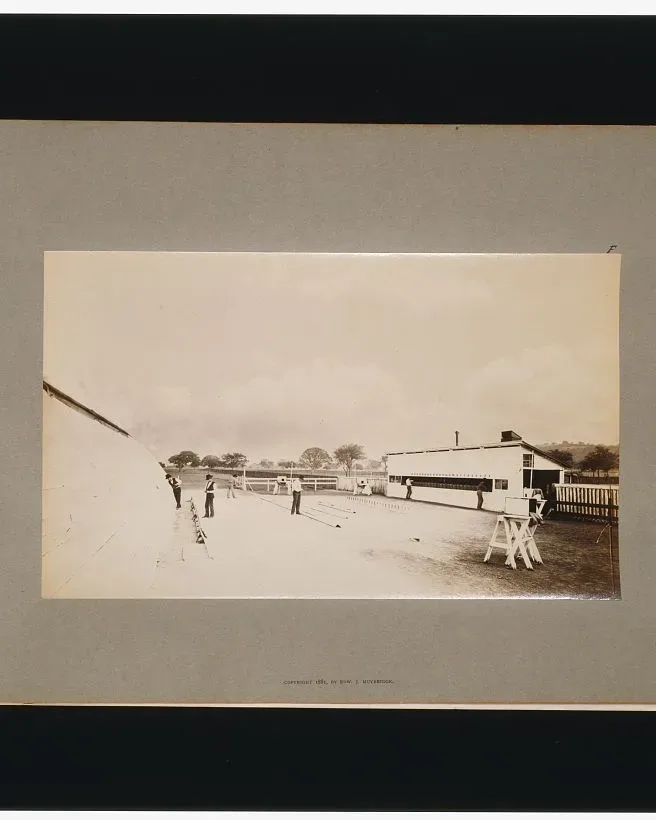
Zoopraxiscope Discs (1893)
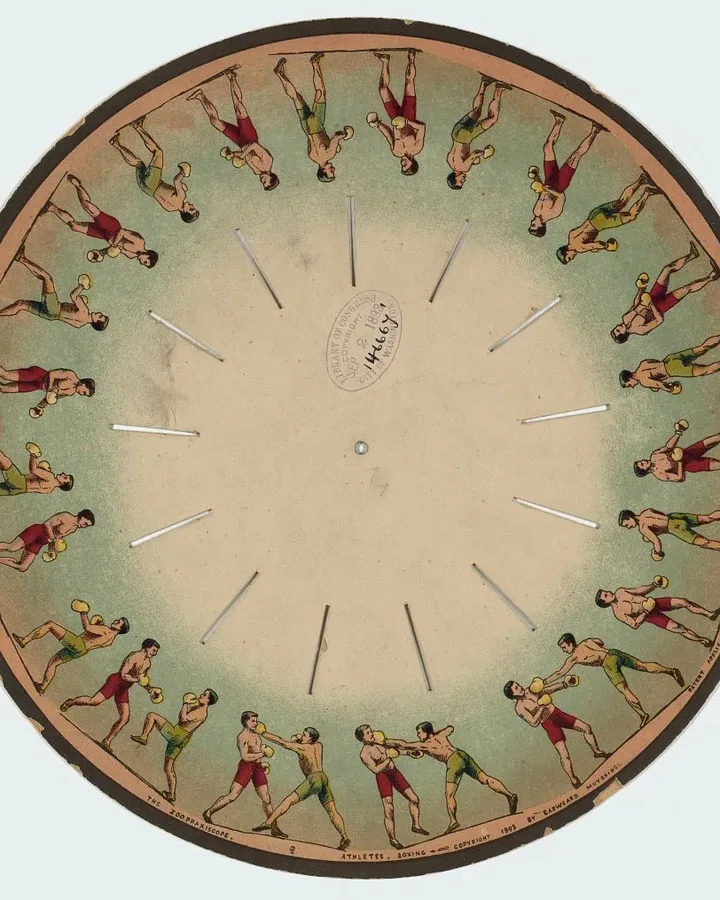
The zoopraxiscope was the projector Muybridge built around 1879-80 to make his sequence photographs move on a screen. These color lithograph discs, copyrighted in 1893, were made for the public at the Chicago World's Fair.
Watch the zoopraxiscope discs move
Each disc below turns one figure per frame, the way the slotted shutter of a zoopraxiscope or a phenakistiscope viewer let the eye see it. Change the speed, reverse the turn or pick another disc. The pictures are the Library of Congress scans of Muybridge's 1893 color discs.
The figures look squat when the disc is still because they were drawn stretched to compensate for the spinning shutter. The animation rotates the scan itself, so the slots and lettering turn too.
- Date
- Copyright 1893 (the zoopraxiscope itself was devised in 1879 and in use from 1880)
- Medium
- Color lithograph discs on paper; the Boxing disc measures 23.8 x 23.6 cm
- Location
- Made for the World's Columbian Exposition, Chicago, 1893; the original projector and glass discs are at Kingston Museum, Kingston upon Thames
- Collection
- Library of Congress Prints and Photographs Division, LOT 10440 (Horse galloping is no. 3)
- Also known as
- The zoopraxiscope--Horse galloping; The zoopraxiscope - a horse back somersault; The zoopraxiscope - a couple waltzing; The zoopraxiscope--Athletes--Boxing; Muybridge zoopraxiscope
What the zoopraxiscope was
The zoopraxiscope was Muybridge's answer to a simple problem: his sequence photographs showed motion broken into separate moments, but audiences wanted to see it restored. He conceived the device in 1879 and had it built by January 1880; early names for it included the zoogyroscope. It was a hand-cranked projector related to the projecting versions of the phenakistiscope, an older optical toy. Images were arranged around the edge of a glass disc, and a slotted shutter disc turning in the opposite direction let each image flash on the screen for an instant. Seen in quick succession, the separate figures blended into a single moving one.
Muybridge used the projector in his public lectures from 1880 until 1895. On 13 March 1882 he lectured at the Royal Institution in London and illustrated the talk with moving images thrown on the screen by the zoopraxiscope.
How the discs were made
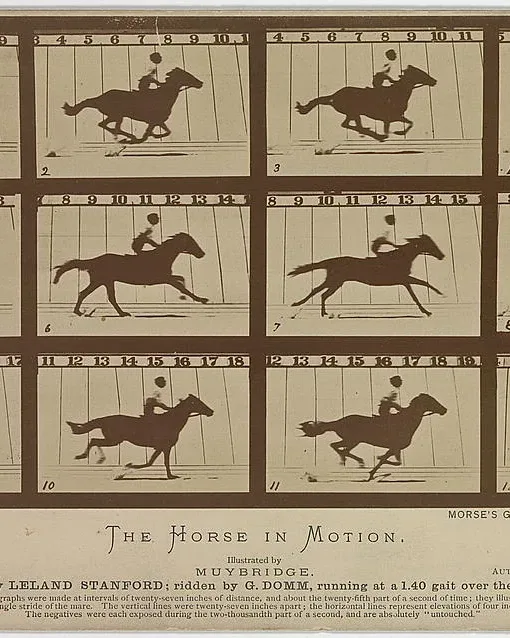
The discs were not simply photographs. On the early 16-inch glass discs, an unidentified artist painted the figures as silhouettes based on Muybridge's photographs, which removed the backgrounds and let him combine figures freely. Only one surviving glass disc uses photographs directly, a horse skeleton shown in different positions. Because projection through the spinning apparatus stretched the image, the figures were drawn in an elongated form to compensate, which is why they look squat or distorted when the disc is still.
A later set of 12-inch glass discs, made between 1892 and 1894, used outlines drawn by Erwin F. Faber that were printed photographically onto the glass and colored by hand. These were probably never used in Muybridge's own lectures.
The 1893 paper discs in this archive
For the 1893 World's Columbian Exposition in Chicago, Muybridge produced a series of paper discs intended for sale to visitors, essentially phenakistiscope discs meant to be spun and viewed through slots. Fifty designs were printed in black and white, and twelve were also issued as color chromolithographs. They sold poorly and are now rare.
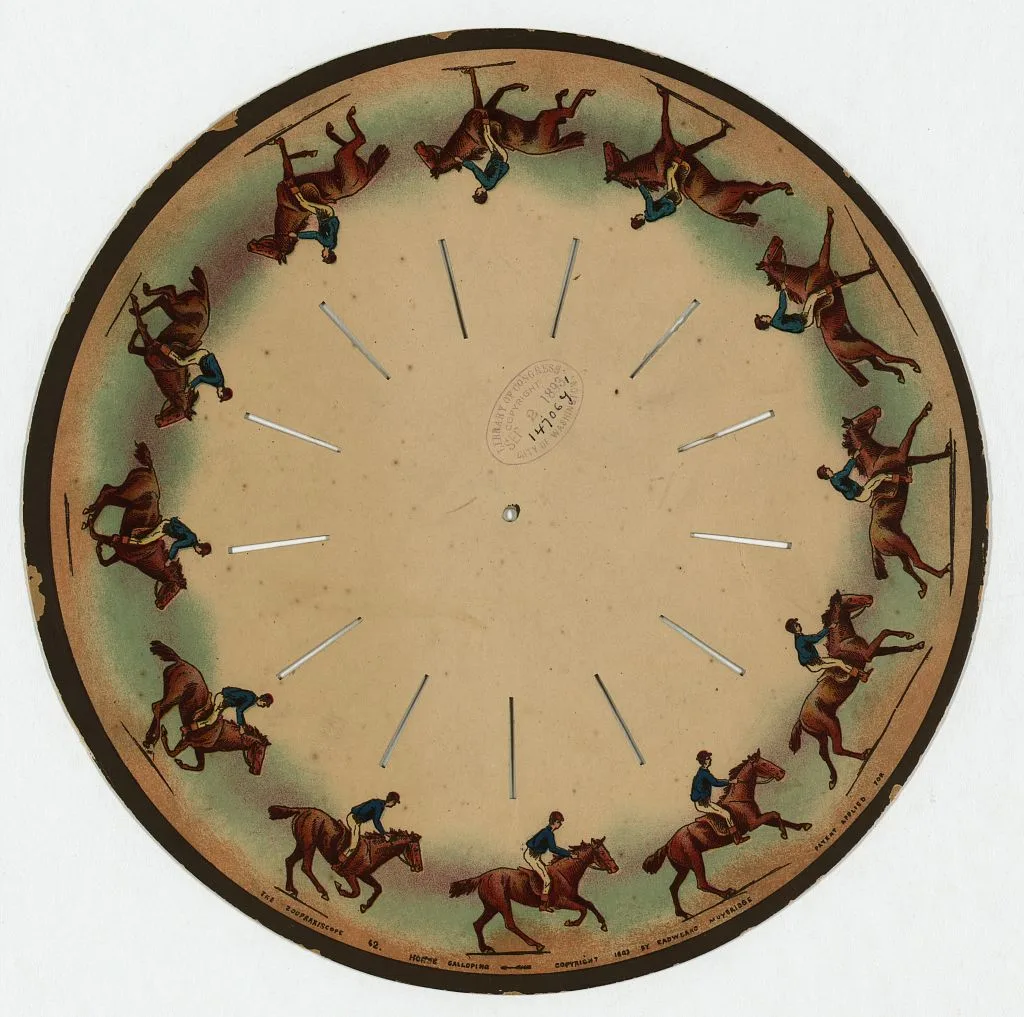
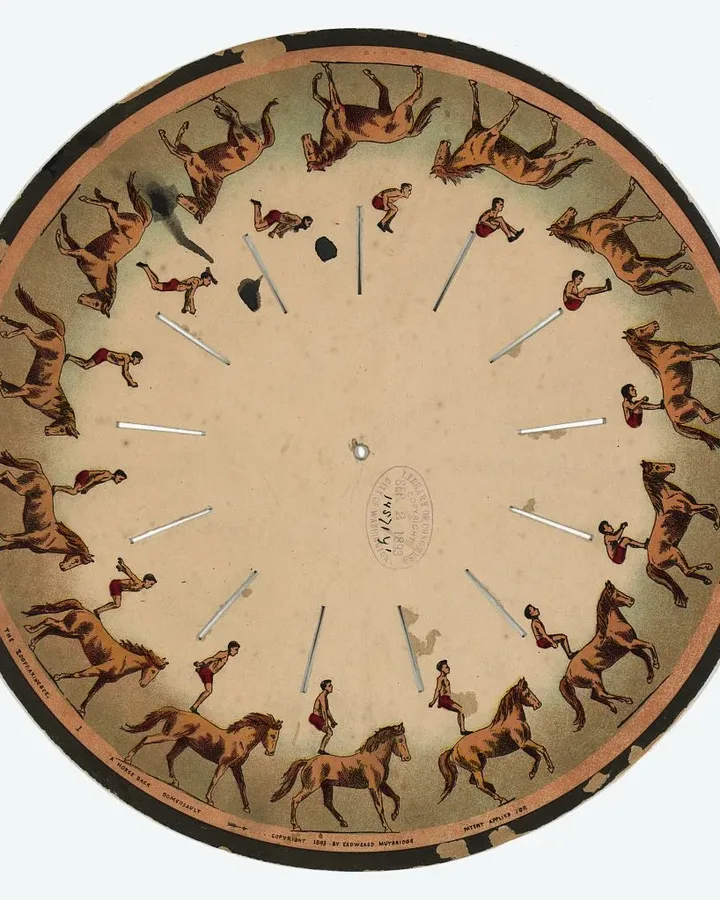
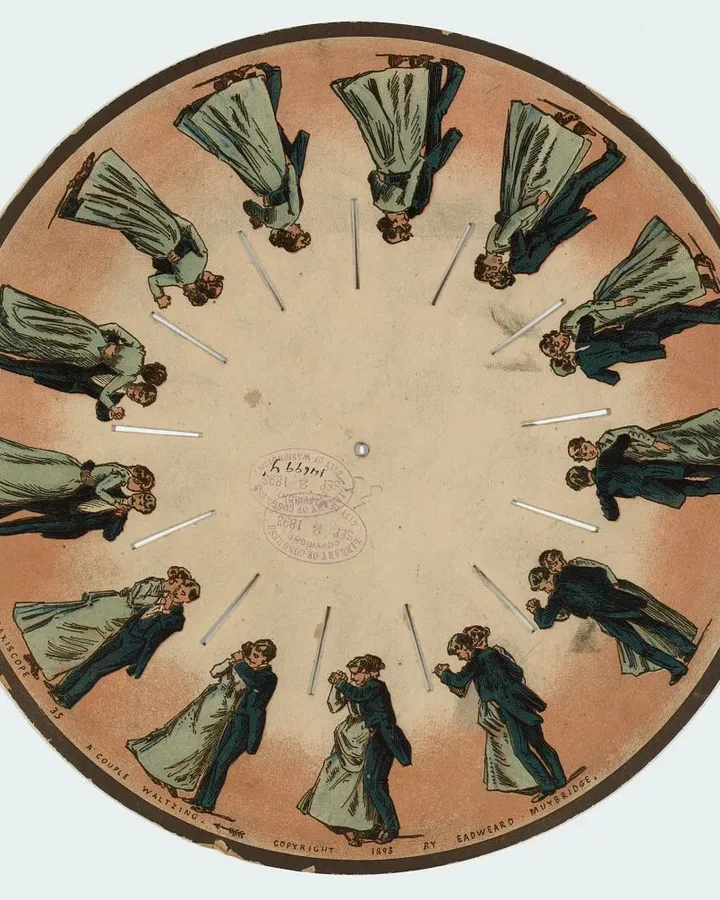
The four discs in this archive are color lithographs from the Library of Congress, each registered for copyright by Muybridge in 1893 and numbered on the disc. The galloping horse with rider is No. 42; the others show a man turning a back somersault on horseback (No. 1), two athletes boxing (No. 2) and a couple waltzing (No. 35). At the Exposition Muybridge also showed his projected pictures to paying audiences in a purpose-built Zoopraxographical Hall, which has been called the first commercial movie theater.
What to look for
The horse disc repeats horse and rider around the circle in a series of slightly different positions, each one a step in the stride. The figures are drawn and colored rather than photographic, closer to an illustration than a photograph. That approach went back to the painted glass discs: with the photographic backgrounds removed, only the moving figure changes from one image to the next.
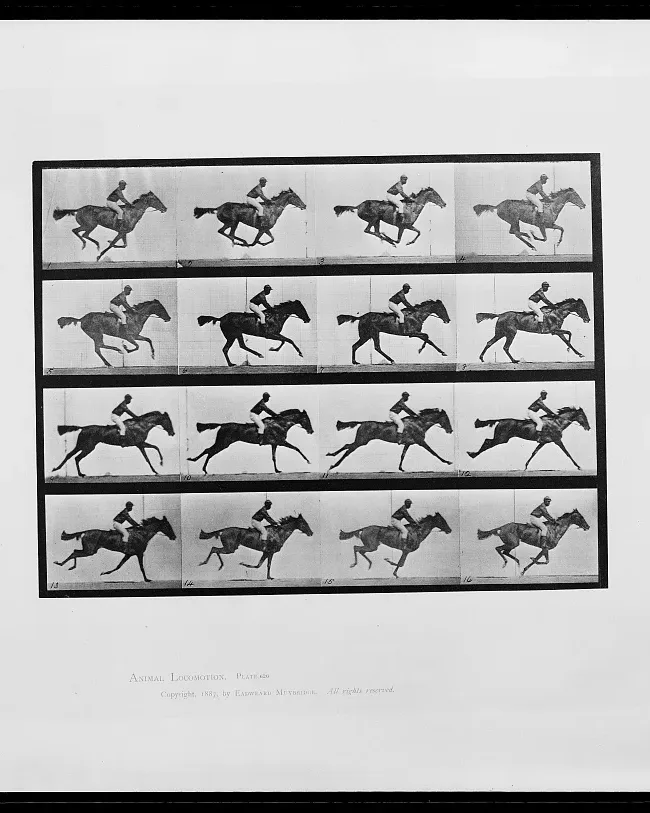
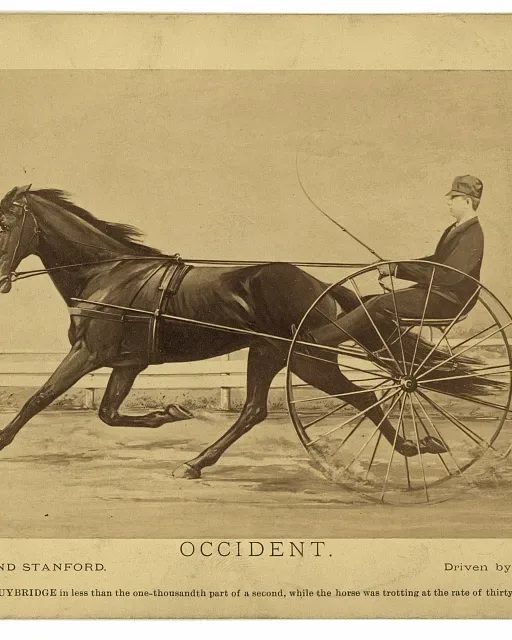
The waltzing couple and the boxers show how Muybridge moved beyond horses to everyday human action, drawing on the sequences he had photographed in Philadelphia for Animal Locomotion.
The zoopraxiscope on the lecture circuit
The projector was the centerpiece of Muybridge's public career. His lecture at the Royal Institution in 1882 was published under the title The Attitudes of Animals in Motion, Illustrated with the Zoopraxiscope, and in it he walked his audience through the Palo Alto apparatus before showing the animals moving on the screen. For the Chicago fair of 1893 he also prepared a booklet, Descriptive Zoopraxography, a first edition of which is in the Kingston collection.
The Library of Congress discs have been exhibited in their own right. The somersault disc was shown in Helios: Eadweard Muybridge in a Time of Change at the Corcoran Gallery of Art in 2010, and the boxing, waltzing and galloping discs traveled in the exhibition Moving Pictures: The Un-easy Relationship between American Art and Early Film, which opened at Williams College in 2005.
Where to see the zoopraxiscope
Muybridge was born in Kingston upon Thames in 1830 and returned there, where he died in 1904. He bequeathed his collection to the town, and Kingston Museum holds the original zoopraxiscope, most of the surviving glass discs and a set of the 50 paper discs. Sources differ slightly on how many glass discs survive worldwide, at roughly seventy, with a few held elsewhere, including at the Cinematheque Francaise. The Science Museum Group holds a replica of a glass disc and shutter, made of glass, card, paint and metal in the Science Museum's own workshop in 1938; the disc is about 41.5 cm across.
The zoopraxiscope is often cited as one of the inspirations for the Kinetoscope developed by Thomas Edison and W. K. L. Dickson.
Other versions in the archive
Frequently asked questions
What is a zoopraxiscope?
It is a projector Muybridge built around 1879-80 to show moving images. Figures painted or printed around a spinning glass disc were flashed onto a screen through a counter-rotating slotted shutter, so they appeared to move.
When was the zoopraxiscope invented?
Muybridge conceived it in 1879 and had it built by January 1880. He used it in public lectures from 1880 until 1895.
Where is Muybridge's zoopraxiscope now?
The original projector is at Kingston Museum in Kingston upon Thames, England, part of the collection Muybridge left to his hometown. The museum also holds most of the surviving glass discs.
Why do the figures on zoopraxiscope discs look stretched?
The images were deliberately drawn in an elongated form to compensate for the distortion produced when the spinning disc was projected. On screen, the proportions looked natural.
Sources
- Library of Congress: The zoopraxiscope--Horse galloping (catalog record 00650866)
- Library of Congress: The zoopraxiscope--Athletes--Boxing (catalog record 00650867)
- Zoopraxiscope (Wikipedia)
- Kingston Heritage: Eadweard Muybridge (1830-1904)
- Science Museum Group: Copy of glass disc and shutter used in Zoopraxiscope (1938-142)
- Eadweard Muybridge (Wikipedia)