Occident (1877) (1877)
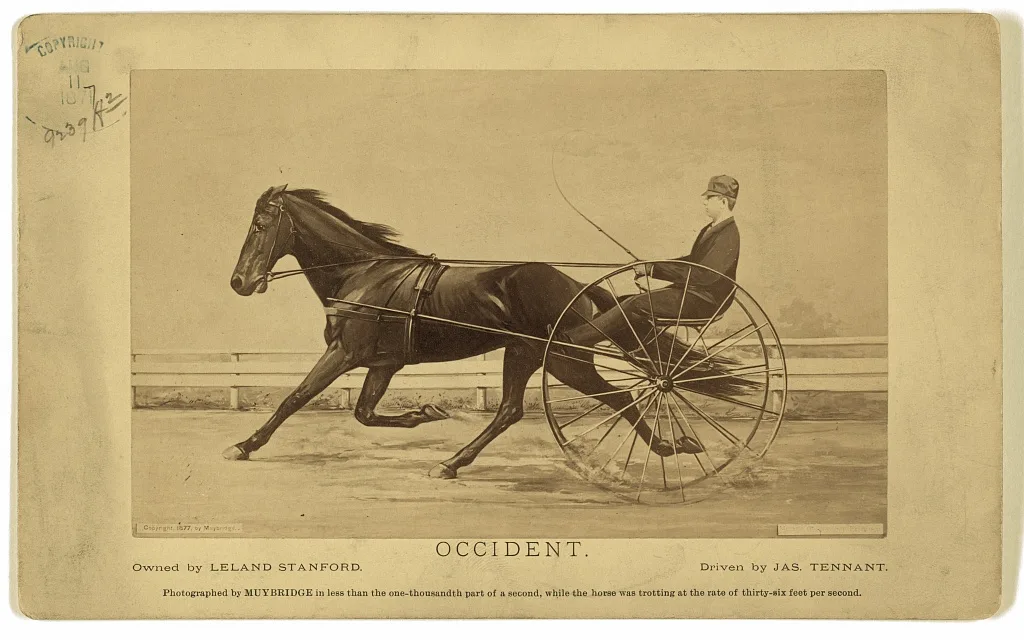
Before the famous sequences of 1878, Muybridge made single photographs of Leland Stanford's champion trotter Occident at full speed. The version he published in August 1877 was heavily retouched, and its back says so.
- Date
- Photographed July 1877; copyright deposit 11 August 1877
- Medium
- Albumen silver print mounted on board (a photograph of a retouched image)
- Location
- Photographed at the Union Park racetrack, Sacramento, California
- Collection
- Library of Congress Prints and Photographs Division, PH - Muybridge (E.), no. 3; copyright deposit H9139
- Also known as
- Occident. Owned by Leland Stanford. Driven by Jas. Tennant; Occident trotting; Muybridge's first horse photograph
Stanford's trotter
Occident was Leland Stanford's favorite trotting horse, and he was the subject of Muybridge's first attempts to photograph a horse at speed. Stanford, who had bought the land that became his Palo Alto Stock Farm in 1876 and used it to breed and train trotting horses, wanted to know whether a trotter at full speed is ever entirely off the ground. Muybridge doubted that a camera could catch a fast-moving horse clearly, but he agreed to try. Accounts date the first attempt to 1872 or 1873: Muybridge himself later said he made a few photographs of a fast trot in 1872, while other sources give 1873. For those first trials Occident was trained to pass in front of white sheets, with more sheets laid on the ground so the legs would stand out, and Muybridge built a spring-driven shutter that reportedly reduced the exposure to about a five-hundredth of a second. In his own account, he took up the problem at the suggestion of the editor of a San Francisco newspaper. That early result was small and blurred, but Stanford was pleased with it. No print of it is known to survive.
The project was then interrupted for several years, a period that included a criminal trial ending in Muybridge's acquittal in February 1875 and a nine-month photographic trip to Central America.
The 1877 photograph
In July 1877 Muybridge returned to the problem at the Union Park racetrack in Sacramento, making a series of progressively clearer single photographs of Occident trotting at racing speed. The published image shows the horse pulling a light sulky with the driver, James Tennant, holding the reins and a whip. A note printed on the front states that it was taken in less than a thousandth of a second while the horse trotted at thirty-six feet per second.
Muybridge registered the photograph for copyright on 11 August 1877, and it was sent to newspapers as an instantaneous photograph.
The retouching
The original negative was too faint and small to publish as it was. What the public saw was a photograph of a painted image made from Muybridge's negative by John Koch, a retouching artist at Morse's Gallery in San Francisco, with a cut-out photograph of Tennant's face glued in place. Muybridge did not hide this entirely. A note on the back of the Library of Congress print says the details were retouched by Koch for better effect, but insists that in every other respect the picture is exactly as the camera made it, down to the driver's whip and the dust kicked up by the hoof.
A critic for the Evening Post suggested the picture was either a fraud or showed a strange-looking horse, but few people seem to have doubted it. The negative itself has never resurfaced, so the extent of the changes cannot be checked.
Why it matters
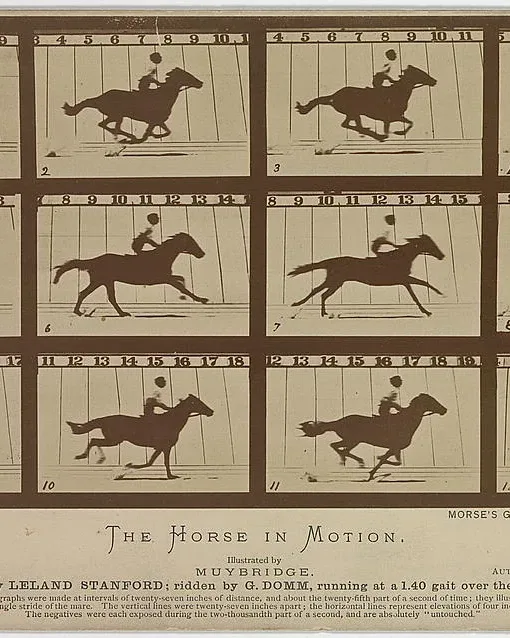
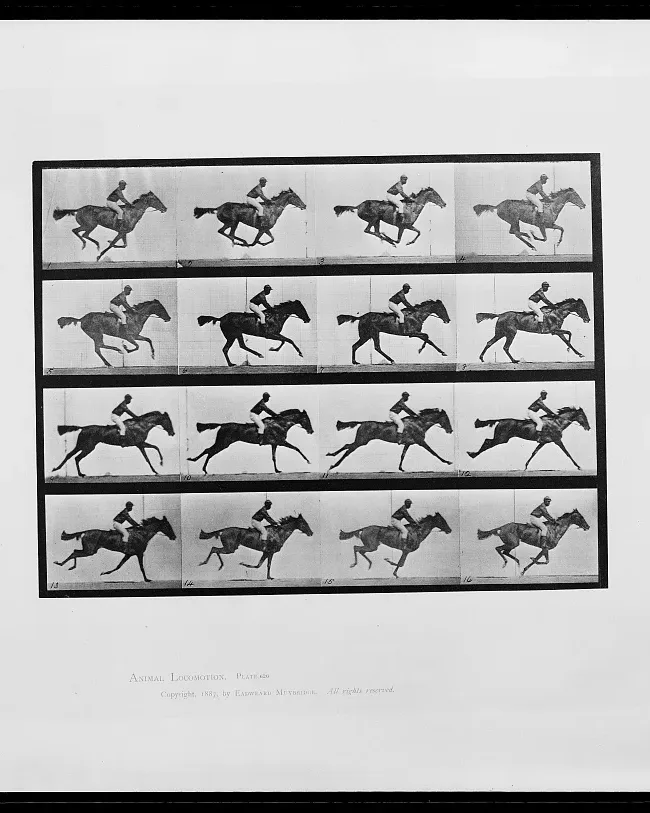
Occident is a hinge in Muybridge's career. A single frame, however fast, could only show one moment, and the retouching controversy made clear that a painted-over picture could not settle a scientific argument. Within a year Muybridge had moved to Stanford's farm at Palo Alto and set up a battery of cameras that recorded a whole stride in sequence, producing the 1878 cards of The Horse in Motion.
Occident appears again in that later work. A card in the 1878 series showed him trotting at Palo Alto on 20 June 1878, and another card reprinted the 1877 single image. Several later Palo Alto sequences in this archive also show Occident pulling a sulky.
The print in this archive
The record here is the Library of Congress copy, an albumen print mounted on board and deposited for copyright in 1877. It is titled Occident. Owned by Leland Stanford. Driven by Jas. Tennant, and it carries both the printed claim on the front and Muybridge's explanation of the retouching on the back. The print was shown in the exhibition Helios: Eadweard Muybridge in a Time of Change at the Corcoran Gallery of Art in Washington in 2010. When the image was reprinted the following year as part of The Horse in Motion series, its card described Occident trotting at a 2:30 gait over the Sacramento track in July 1877. Together, the 1877 print and that card are the earliest published records of the motion work that would occupy Muybridge for the rest of his career.
Frequently asked questions
What was the name of Stanford's horse that Muybridge first photographed?
The first horse was Occident, Leland Stanford's champion trotter. Muybridge photographed him in the early 1870s and again, more successfully, at Sacramento in July 1877.
Was Muybridge's Occident photograph faked?
It was heavily retouched. The published image was a photograph of a painting made from the negative by Morse's Gallery artist John Koch, with the driver's face pasted in, and a note on the back admits the retouching while insisting the rest is faithful to the camera.
Who was driving Occident in the photograph?
The driver named on the print is Jas. (James) Tennant.
Why is the Occident photograph important?
It was Muybridge's first published attempt to freeze a horse at full speed and led directly to the multi-camera sequences of 1878. Because the image was retouched and the original negative is lost, it could not settle Stanford's question on its own.
Sources
- Library of Congress: Occident. Owned by Leland Stanford. Driven by Jas. Tennant (catalog record 2005694393)
- The Horse in Motion (Wikipedia)
- Eadweard Muybridge (Wikipedia)
- Muybridge, The Attitudes of Animals in Motion, Illustrated with the Zoopraxiscope (Royal Institution lecture, 13 March 1882), Project Gutenberg
- Stanford Red Barn: History (Palo Alto Stock Farm)