The Horse in Motion (1878)
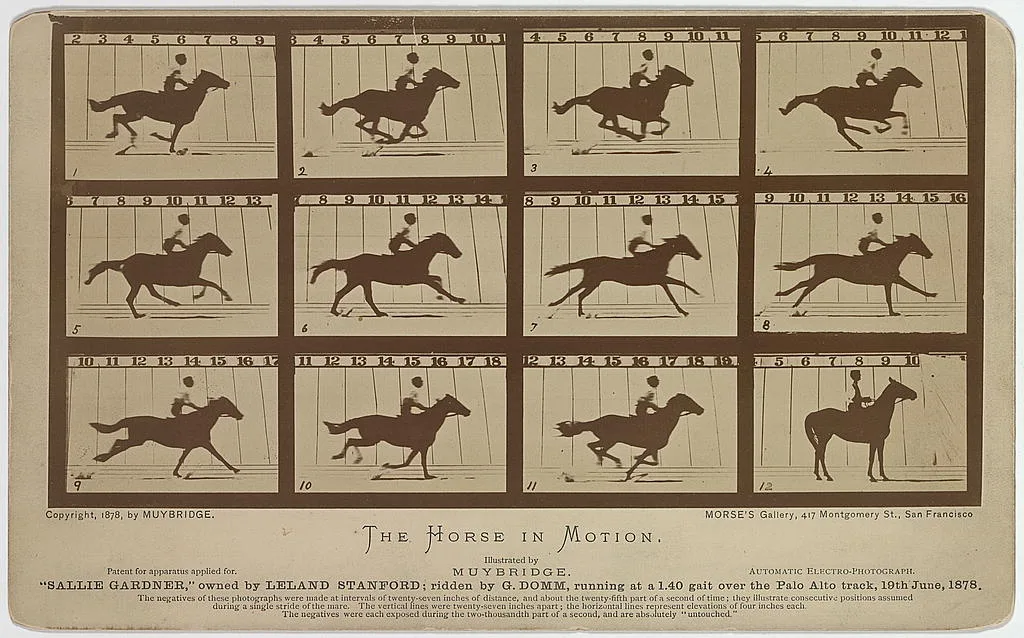
Twelve small photographs of Leland Stanford's mare Sallie Gardner, made at Palo Alto on 19 June 1878, showed for the first time what a horse's legs actually do at a gallop. The card is the best known of Muybridge's images and a landmark on the road to motion pictures.
- Date
- Photographed 19 June 1878; published as a cabinet card in 1878
- Medium
- Albumen print on card, twelve frames (published by Morse's Gallery, 417 Montgomery St., San Francisco)
- Location
- Made at Leland Stanford's Palo Alto Stock Farm, California (now the Stanford University campus)
- Collection
- Library of Congress Prints and Photographs Division, LOT 3081; copyright deposit 2437K2
- Also known as
- Sallie Gardner at a Gallop; Sallie Gardner Running; The Horse in Motion. "Sallie Gardner," owned by Leland Stanford; running at a 1:40 gait over the Palo Alto track, 19th June 1878; Automatic Electro-Photograph
The question behind the picture
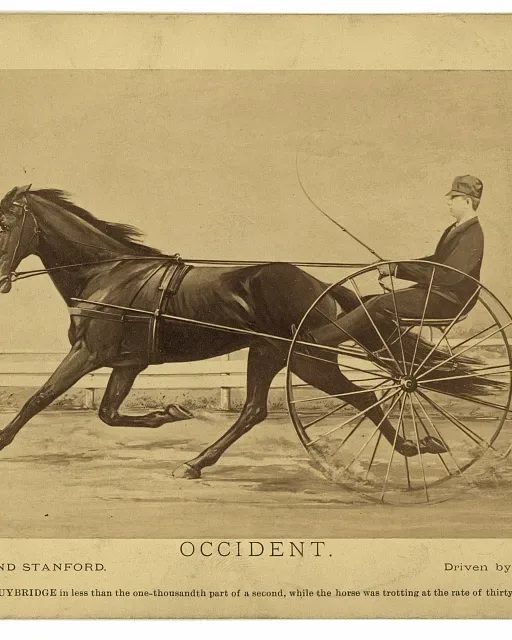
Leland Stanford, the railroad magnate and former governor of California, bred and raced horses at his Palo Alto Stock Farm. He believed that painters and printmakers had been drawing running horses wrongly, and he engaged Muybridge, then one of the best-known landscape photographers in the West, to find out what really happens during a stride. The specific question was whether all four hooves ever leave the ground at once. Muybridge had already made single photographs of Stanford's trotter Occident in the 1870s, but one frame could not show the whole cycle of a stride.
The story that Stanford commissioned the work to win a bet is often repeated, but historians have found no primary account of such a wager, and it is best treated as legend.
How the photographs were made
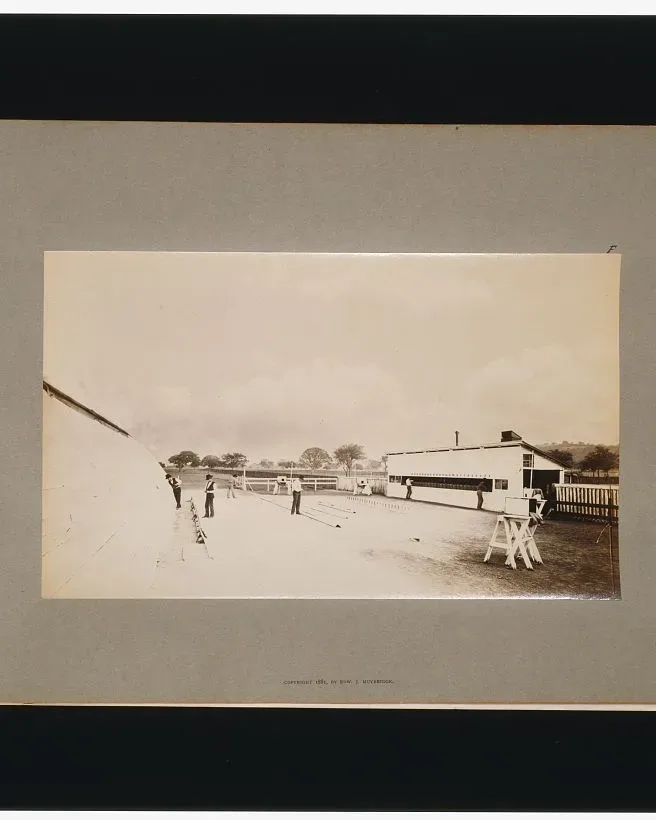
For the June 1878 sessions Muybridge set up a battery of twelve cameras in a shed beside the track at Palo Alto, facing a slanted white background ruled with vertical lines. As the horse passed, it tripped each camera in turn. In his own later account Muybridge described threads stretched across the track at chest height: the animal broke them one after another, closing an electric circuit that fired an electrically released shutter. The shutters were fast enough to freeze the legs; contemporary claims put the exposures at around a thousandth of a second, and Muybridge later said some exposures were far shorter still.
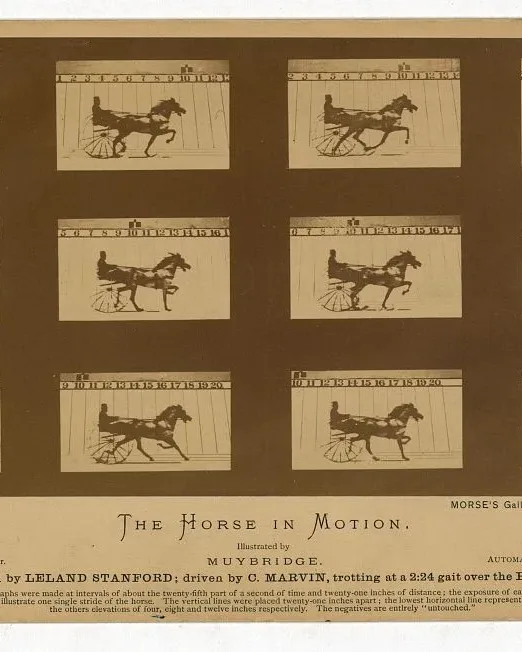
The sessions were held over several days. On 15 June he demonstrated the apparatus with the trotter Abe Edgington before reporters and racing men, and the resulting card is also held in this archive. Four days later, on 19 June, the thoroughbred mare Sallie Gardner ran past the cameras with a rider identified as G. Domm. A saddle girth broke as she went by, and the slipping girth can be seen in the frames.
What the frames show
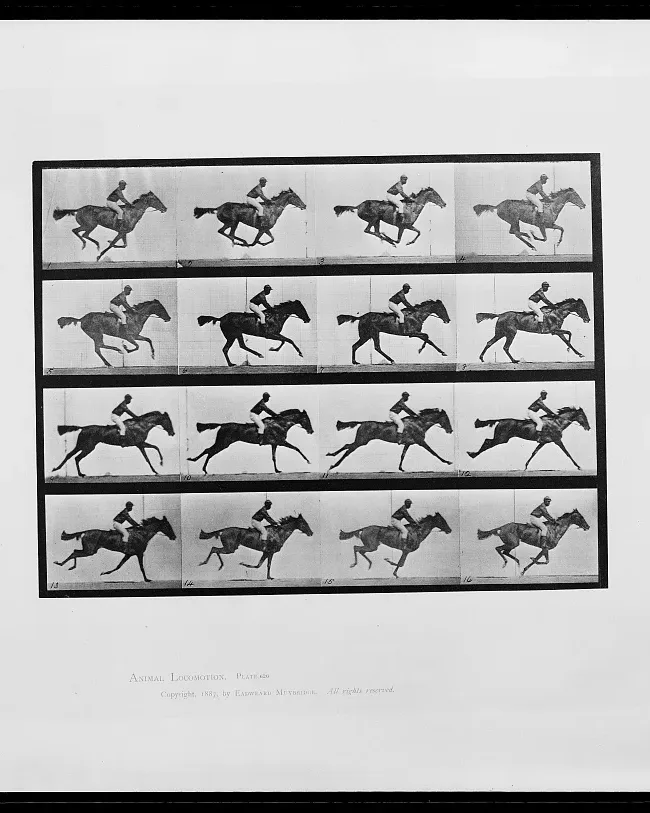
The card carries twelve numbered frames arranged in rows, each a dark silhouette of horse and rider against the pale background. Read in order, they follow the horse through the phases of its stride. In one of them all four hooves are clear of the ground. The surprise was where the legs were at that moment. Painters had long shown galloping horses with their legs stretched fore and aft, like a rocking horse. Muybridge's frames showed that the horse leaves the ground with its legs gathered underneath its body, not extended.
The pictures are small and lack detail; the negatives were tiny and the figures read almost as shadows. That plainness is part of their force. The vertical lines of the background let a viewer measure how far the horse moved between frames, and the caption records the run as a 1:40 gait over the Palo Alto track.
Reception and why it became famous
Muybridge registered the cards for copyright and they were sold through Morse's Gallery in San Francisco, with titles printed on the front and a description of each frame on the back. Six different sequences were issued under the title The Horse in Motion, covering trotting, walking, cantering and running, and they sold for $1.50 each. Editions followed in German as Das Pferd in Bewegung and in French as Les Allures du Cheval. At home the reaction was one of surprise: the Sacramento Daily Union reported that the supposedly graceful action of a running horse was "a delusion," since the feet were caught in odd positions. The news spread quickly. Scientific American put engravings based on the cards on its cover in its issue of 19 October 1878, and the French journal La Nature published the series that December, where the physiologist Etienne-Jules Marey, already studying animal movement, responded with enthusiasm.
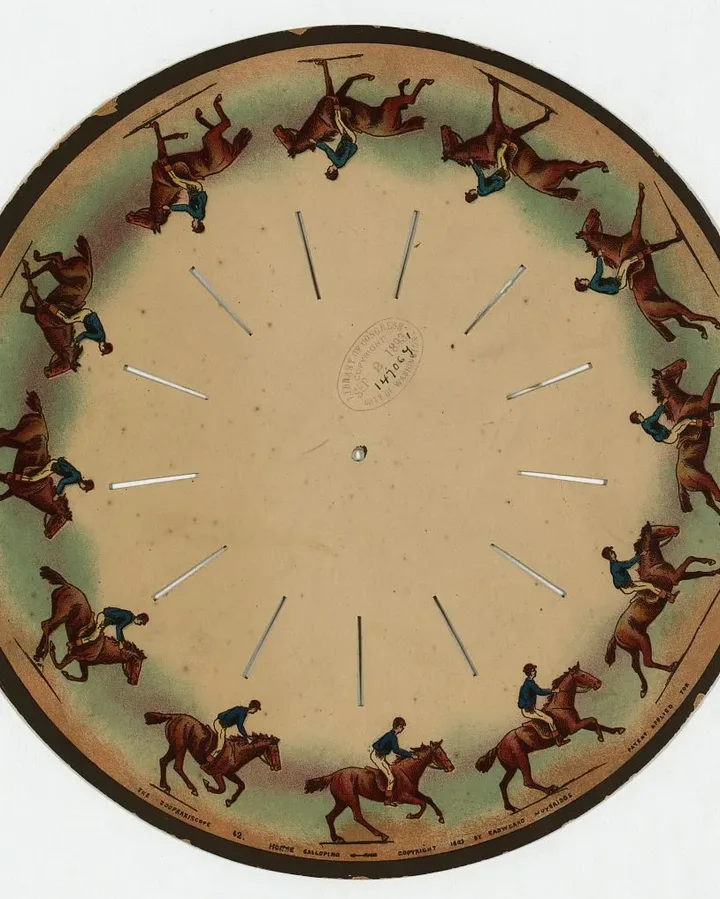
Muybridge began lecturing with the pictures within weeks, first projecting them as still lantern slides. By 1880 he could project them in motion with his zoopraxiscope, and the galloping horse became the image most closely tied to his name.
Versions, and the copies in this archive
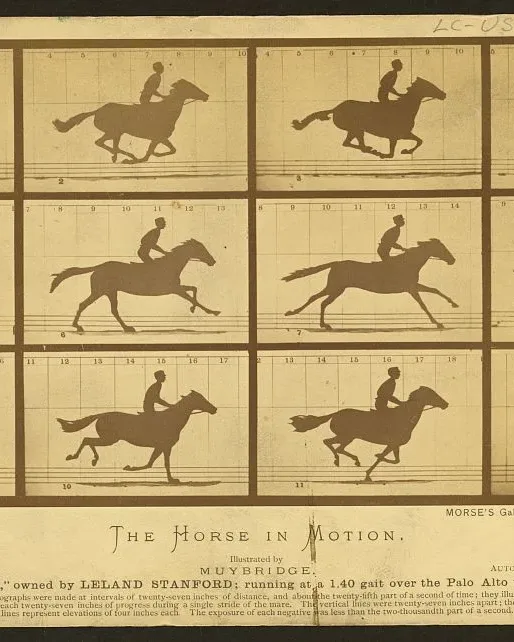
The record shown here is the Library of Congress copy of the Sallie Gardner card, an albumen print on its original card mount with the Morse's Gallery imprint and the words Automatic Electro-Photograph. The Library holds a second copy from the same negative in its Motion Picture, Broadcasting and Recorded Sound Division. This archive also holds a related print, a version of the Sallie Gardner card illustrated with a diagram of the foot movements, and the companion card of Abe Edgington trotting at a 2:24 gait on 15 June 1878. A later edition of the Sallie Gardner card had the outlines retouched to make the figures crisper.
Many animations circulating online under the Sallie Gardner name are actually built from Muybridge's later Philadelphia plates of the mare Annie G., which are sharper and have more frames. The site where the Palo Alto work was done is marked by California Historical Landmark No. 834 on the Stanford campus.
Other versions in the archive
Frequently asked questions
What did Muybridge's horse in motion prove?
It showed that a galloping horse has all four hooves off the ground at one moment of its stride. It also showed that this happens when the legs are tucked under the body, not stretched out front and back as painters had long drawn them.
What was the name of the horse in The Horse in Motion?
The best-known card shows Sallie Gardner, a thoroughbred mare owned by Leland Stanford, photographed running at Palo Alto on 19 June 1878. Other cards in the same series show Stanford's horses Abe Edgington, Mahomet and Occident.
How many cameras did Muybridge use for the galloping horse?
The June 1878 sessions used a battery of twelve cameras lined up beside the track. In 1879 Muybridge expanded the setup to 24 cameras for further studies at Palo Alto.
Did Leland Stanford make a bet about the horse?
The bet story is popular but unproven. Historians have found no primary account of a wager, and Stanford's interest is documented as a question about how horses move.
Is The Horse in Motion the first movie?
Not exactly. It is a series of still photographs, but projected in sequence on Muybridge's zoopraxiscope from 1880 the images appeared to move, which makes the series an important forerunner of cinema.
Sources
- Library of Congress: The Horse in motion. "Sallie Gardner" (catalog record 97502309)
- Library of Congress: The Horse in motion. "Abe Edgington" (catalog record 91483062)
- The Horse in Motion (Wikipedia)
- IEEE Spectrum: June 1878: Muybridge Photographs a Galloping Horse
- Muybridge, The Attitudes of Animals in Motion, Illustrated with the Zoopraxiscope (Royal Institution lecture, 13 March 1882), Project Gutenberg
- California Historical Landmark No. 834: Eadweard Muybridge and the Development of Motion Pictures (California Office of Historic Preservation)