Panorama of San Francisco from California Street Hill (1877)
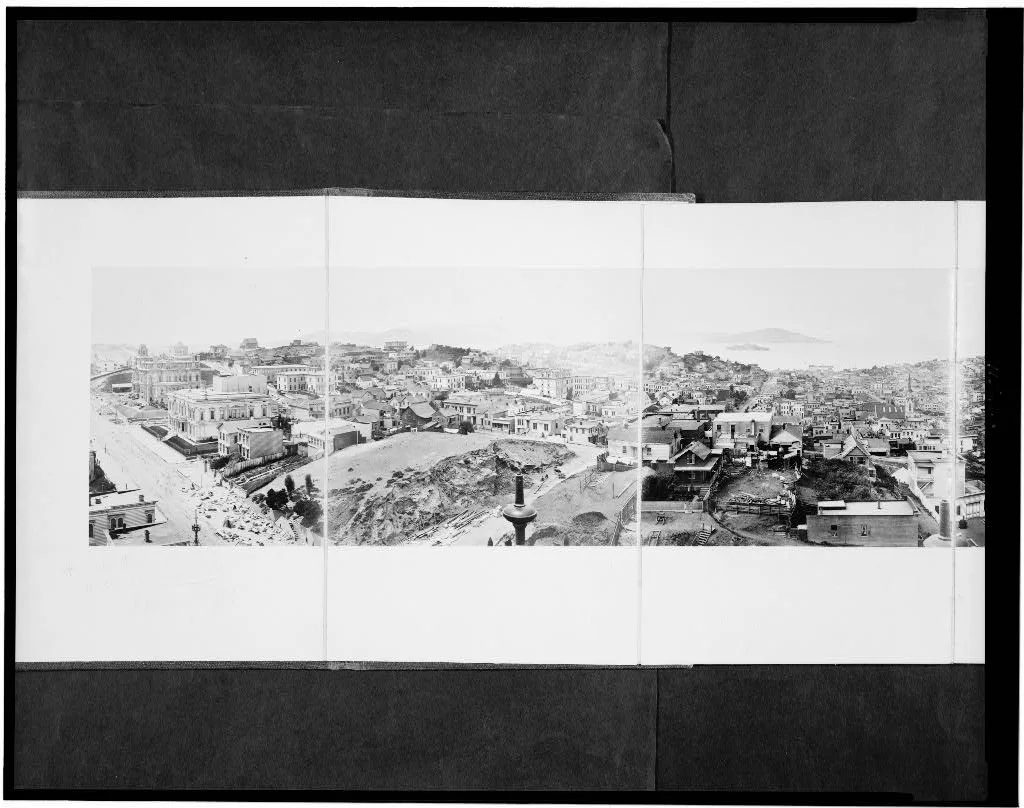
In 1877 Muybridge climbed the tower of Mark Hopkins's unfinished mansion on Nob Hill and photographed San Francisco in a full circle. The eleven joined prints make one of the great city views of the nineteenth century.
- Date
- 1877 (copyright 1877)
- Medium
- 11 albumen prints mounted in an album, with a separate photographic key; about 7.5 x 86.5 in. overall
- Location
- Photographed from the tower of the Mark Hopkins house, California and Mason Streets, Nob Hill, San Francisco
- Collection
- Library of Congress Prints and Photographs Division, PH - Muybridge (E.) no. 2 (Portfolio); purchased 1994
- Also known as
- Panorama of San Francisco from California Street Hill (1877); Panorama of San Francisco from California-St. Hill; Muybridge San Francisco panorama; Nob Hill panorama
A city seen from its highest point
Long before his motion studies, Muybridge was famous in California as a photographer of landscapes and cities. In 1877, while his experiments for Leland Stanford were under way, he set up his camera in the central tower of the house that the railroad financier Mark Hopkins was building at the corner of California and Mason Streets, on the summit then called California Street Hill and now known as Nob Hill. From there he could turn the camera through a full circle and record the city in every direction.
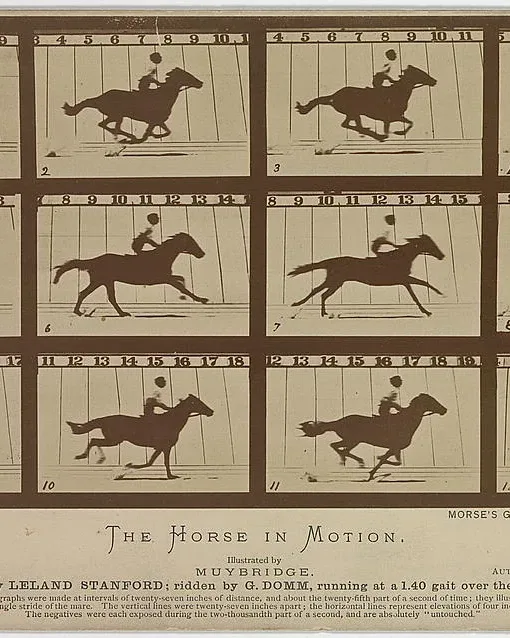
The panorama was published by Morse's Gallery in San Francisco, which also issued his horse photographs, and the title, credit and copyright were printed on the central plate.
How it was made
Muybridge made the panorama as a series of separate photographs, turning the camera a little each time so that the edges of each view would meet the next. According to his biographer David Harris, he began in the late morning facing southwest and worked clockwise, away from the sun, finishing in mid-afternoon; the whole sequence took about five hours, during which the sun moved some 90 degrees across the sky. Because of that time span, the light and shadows change from panel to panel, and the city does not quite line up as a single instant.
The finished prints were mounted side by side, accordion-style, so the panorama could be folded into a book or opened into a strip roughly seven feet long.
What to look for
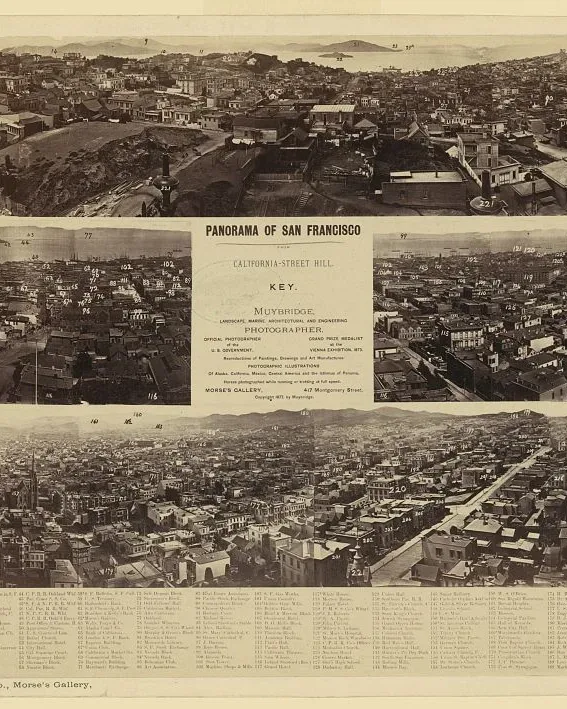
The panorama rewards slow looking, panel by panel. The Library of Congress copy is accompanied by a photographic key, also in this archive, on which landmarks are numbered and named below the image, so a nineteenth-century viewer could find specific buildings. The key is a reduced, rephotographed version of the segmented panorama, and its caption lists Muybridge's credentials as a landscape, marine, architectural and engineering photographer.
Because the panels were exposed over several hours, the light is not uniform from one end of the panorama to the other, a record of the hours that passed as Muybridge worked.
The 1877 and 1878 versions
Muybridge photographed the same view twice. The 1877 panorama, the one held here, is made of eleven prints. In 1878 he repeated it on a much larger scale, with thirteen mammoth plates each 20 by 24 inches, exposed by the wet-collodion process for 15 to 25 minutes apiece. Mounted as an accordion-folded album, the 1878 version stretches to about 17.5 feet. Nine copies of the mammoth version are known, and the one at Kingston Museum is the only copy outside the United States.
The two versions are easy to confuse, so check the date and the number of panels when comparing reproductions.
Muybridge the landscape photographer
The printed caption on the key doubles as an advertisement, and it shows how Muybridge presented himself in 1877. It calls him a landscape, marine, architectural and engineering photographer and official photographer of the U.S. Government, notes a prize medal from the Vienna Exhibition of 1873, and offers photographic illustrations of Alaska, California, Mexico, Central America and the Isthmus of Panama. Almost as an afterthought it adds horses photographed while running or trotting at full speed, the work that would soon eclipse everything else he did.
The 1878 mammoth version shows how much care he took. Kingston's study of its copy found that he began in mid-morning, probably with at least one assistant, and that he rephotographed the seventh plate for reasons that are not known. The finished prints were trimmed to 16 by 22 inches and mounted on linen-backed paper. Muybridge gave a copy of the 1878 panorama to Stanford's wife.
This copy and its history
The Library of Congress copy carries the front inscriptions Muybridge, Photo and Morse's Gallery, the copyright notice for 1877, and a pencil dedication to Arthur Rodgers with Muybridge's compliments. The Library bought it in 1994, and it is catalogued with the key as a set of twelve prints. Some copies survive in their original maroon covers with gilt titles. Other copies of the 1877 panorama have appeared at auction; one, from the Pier 24 Photography collection in San Francisco, was offered by Sotheby's in 2023 with an estimate of $30,000 to $50,000, and the scholarship on the panorama is gathered in David Harris's book on Muybridge and the photographic panorama of San Francisco.
Other versions in the archive
Frequently asked questions
Where did Muybridge take his San Francisco panorama from?
From the tower of Mark Hopkins's house at California and Mason Streets on Nob Hill, then called California Street Hill. It was one of the highest points in the city.
How many panels are in Muybridge's San Francisco panorama?
The 1877 version has eleven prints. The larger 1878 version has thirteen mammoth plates, each 20 by 24 inches.
How long did the San Francisco panorama take to make?
About five hours for the 1877 version, from late morning to mid-afternoon, according to Muybridge's biographer David Harris. The 1878 mammoth version took four to five hours.
Where can I see the 1878 mammoth panorama?
Nine copies are known, and Kingston Museum in Kingston upon Thames holds the only one outside the United States. The Library of Congress holds the 1877 eleven-panel version shown here.
Sources
- Library of Congress: Panorama of San Francisco from California Street Hill (catalog record 2007664634)
- Library of Congress: Panorama of San Francisco from California Street - Hill, key (catalog record 2007663628)
- Sotheby's: Eadweard Muybridge, Panorama of San Francisco, from California-St. Hill (Pier 24 sale, 2023)
- Kingston Heritage: Muybridge's San Francisco Panorama in 1878
- Pillar to Post: Retro files, Muybridge 1877 photos of San Francisco
- Eadweard Muybridge (Wikipedia)