Animal Locomotion (1887)
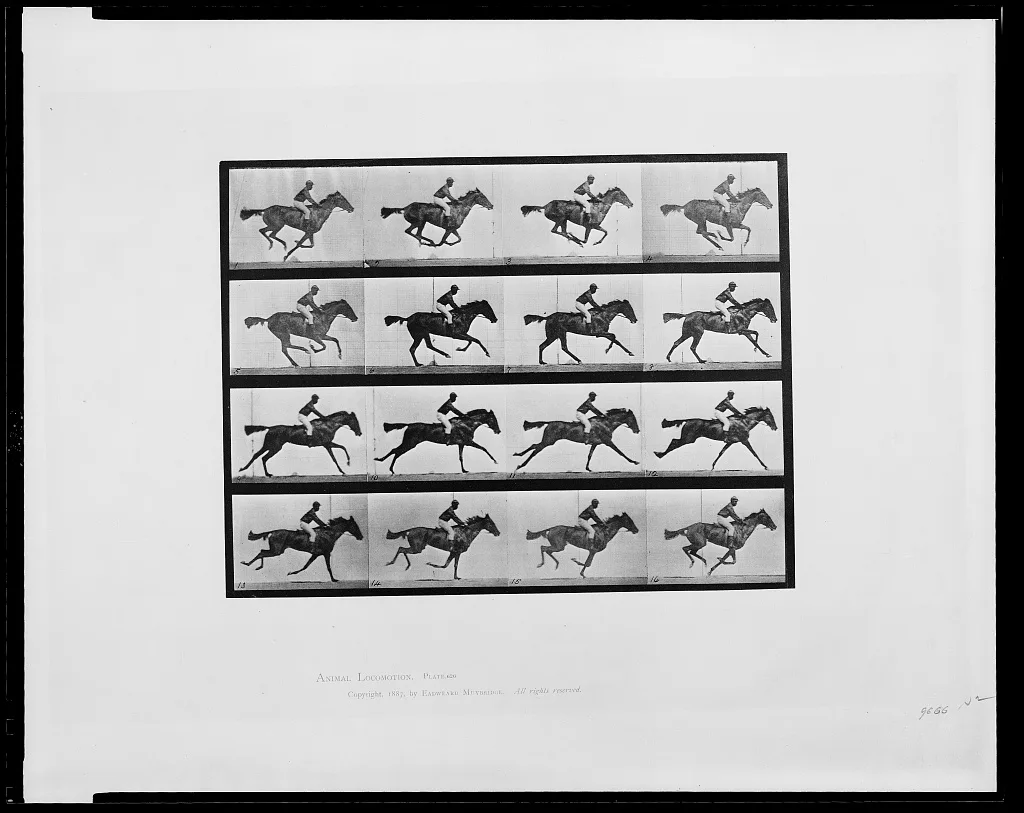
Animal Locomotion is Muybridge's largest work: 781 plates of men, women, children and animals in motion, photographed at the University of Pennsylvania and published in 1887. Its most famous plate, No. 626, shows the mare Annie G. at a gallop.
- Date
- Photographed 1884-1885; published 1887
- Medium
- Collotype plates (781 in the complete work); Plate 626 shows the mare Annie G. galloping
- Location
- Made at the University of Pennsylvania, Philadelphia, with sessions at the Philadelphia Zoo and the Gentlemen's Driving Park
- Collection
- Library of Congress Prints and Photographs Division, LOT 3309, plate 626; the University of Pennsylvania Archives holds a near-complete set
- Also known as
- Animal Locomotion: An Electro-Photographic Investigation of Consecutive Phases of Animal Movements; Plate 626, "Annie G." galloping; Gallop; thoroughbred bay mare, Annie G.; Animal locomotion - 16 frames of racehorse "Annie G." galloping
From Palo Alto to Philadelphia
After his work for Leland Stanford ended, Muybridge looked for a new sponsor for a larger study of movement. In 1883 Fairman Rogers invited him to lecture in Philadelphia, and a group of Philadelphians meeting in the office of Provost William Pepper agreed to give him the use of grounds at the University of Pennsylvania's veterinary hospital and an advance of $5,000. The university's trustees appointed a commission to oversee the project. Its members included the painter Thomas Eakins, who taught at the Pennsylvania Academy of the Fine Arts and was conducting motion experiments of his own.
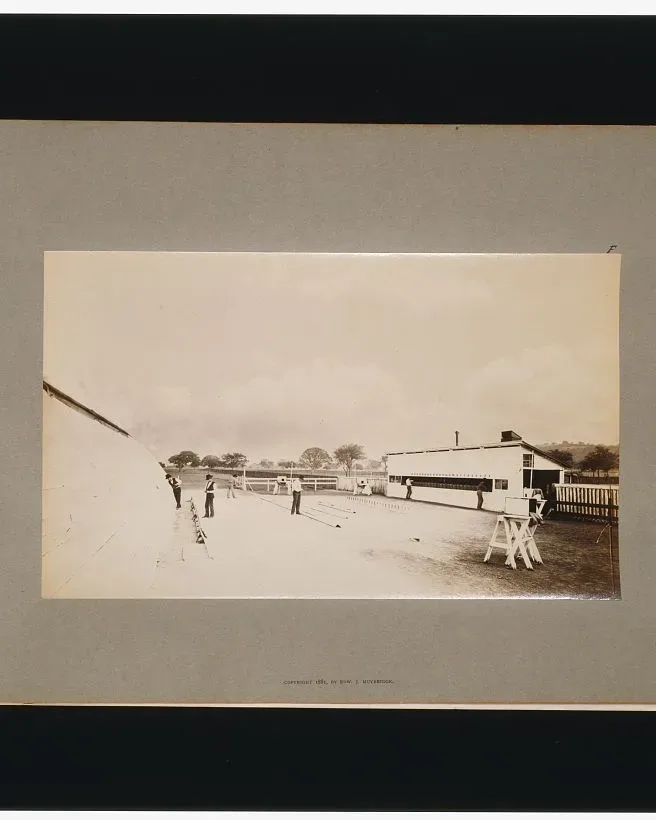
Early in 1884 the university built Muybridge an outdoor studio at the northeast corner of 36th and Pine Streets, built around a three-sided black shed. He worked there from spring 1884 into the autumn of 1885.
How the plates were made
Muybridge now had far better equipment than at Palo Alto. He used batteries of cameras whose shutters were released by electromagnets at equal intervals, so that a sequence no longer depended on the subject tripping threads. He worked with several batteries of cameras, so that many actions could be recorded from more than one angle at once, side, front and rear. He also switched from wet collodion to the newer dry plates, which allowed shorter exposures. Thomas Eakins, who worked with him briefly, preferred to record a movement as multiple exposures on a single negative; Muybridge kept to his rows of separate cameras, which produced the clean grids of individual frames that the plates are known for.
Over the two seasons he produced more than 100,000 images. From these he assembled 781 plates, each a grid of up to 36 pictures, published as collotypes. Historians have shown that the plates are not always the neutral records they appear to be: Muybridge sometimes cropped, omitted or combined frames to produce a cleaner sequence.
Who and what the plates show
The great majority of plates show people. Penn professors and students posed, and an 1886 report in the student paper said nearly every well-known university athlete of recent years had taken part, running, jumping, vaulting and wrestling. Women from the city were photographed walking, carrying water, dancing and doing household tasks; patients from the neighboring Blockley Almshouse were photographed to record abnormal movement; and Muybridge photographed himself, describing himself in the catalogue as an ex-athlete of about sixty. In the catalogue, male models were classified by profession and female models by marital status, age and build. Many of the models are nude or lightly clothed, which made the plates useful to artists and has made them a subject of scholarly study.
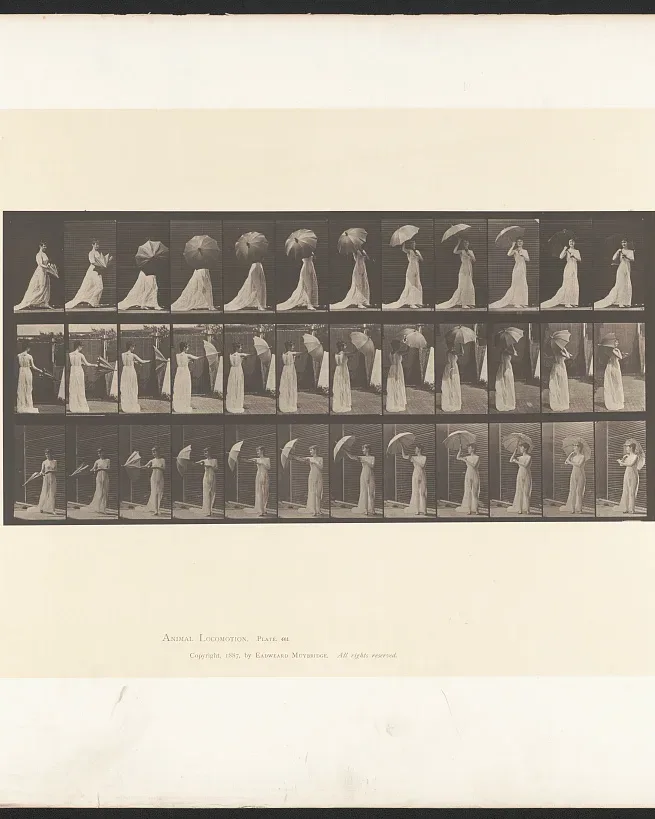
About 220 plates show animals. Muybridge spent several weeks in 1884 and 1885 photographing at the Philadelphia Zoo, and the thoroughbred horses were photographed at the Gentlemen's Driving Park. The plates in this archive include an elephant walking, a cat running, a gull in flight and a woman opening an umbrella.
Plate 626: Annie G. galloping
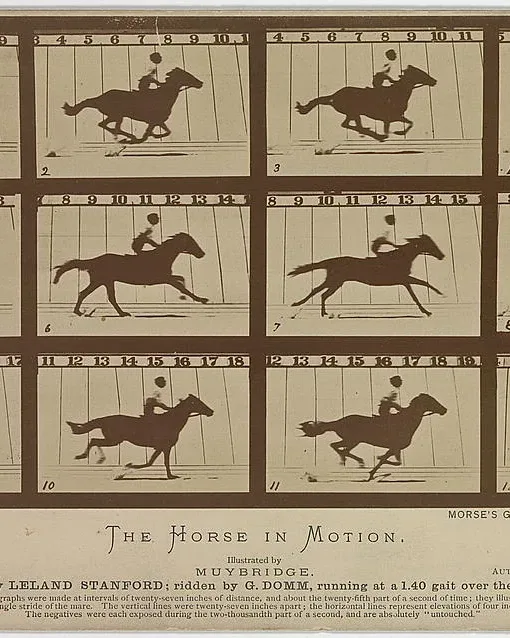
The record featured here is Plate 626, a sequence of the thoroughbred bay mare Annie G. at a gallop with a rider. The Library of Congress copy is a collotype from the 1887 publication. Its frames are much sharper than the Palo Alto cards of 1878, and they let you follow every change in the position of the legs, including the moment when all four hooves are off the ground with the legs gathered under the body.
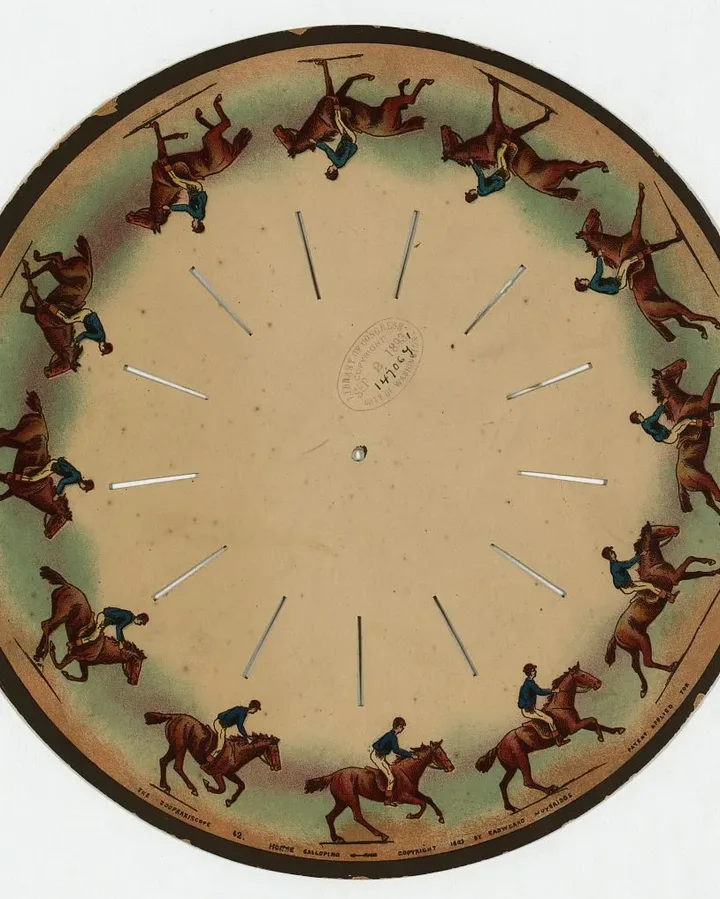
Animated versions of the Annie G. frames have become some of the most widely seen moving images of the nineteenth century. They were used in a Google Doodle on 9 April 2012 for Muybridge's 182nd birthday, and they appear in Jordan Peele's 2022 film Nope. These animations are often mislabeled as Sallie Gardner, the horse of 1878.
Publication and legacy
Animal Locomotion was published in 1887 under the auspices of the University of Pennsylvania. It was sold by subscription: a subscriber paid $100 for a set of 100 plates chosen from the 781. The complete set of eleven volumes cost $600, and reportedly only 37 complete sets were made. Subscribers included scientists, artists and institutions; the South Kensington Museum in London, now the Victoria and Albert Museum, bought plates this way.
The plates became a standard reference for artists, and their influence runs through Thomas Eakins and Marcel Duchamp to Sol LeWitt and Philip Glass, whose 1982 opera The Photographer used a slide show of the studies. The University of Pennsylvania Archives holds an almost complete set of the plates.
Other versions in the archive
Animal locomotion
1887
Animal locomotion. Plate 461
1887
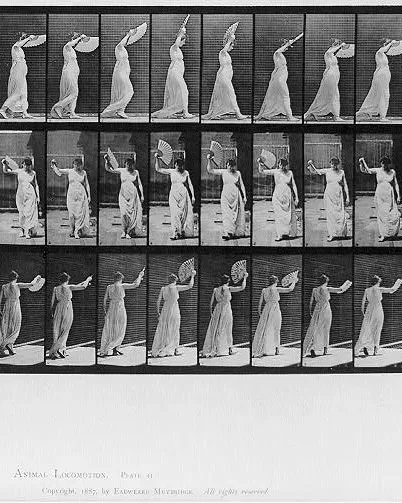
Animal Locomotion. Plate 41
1887
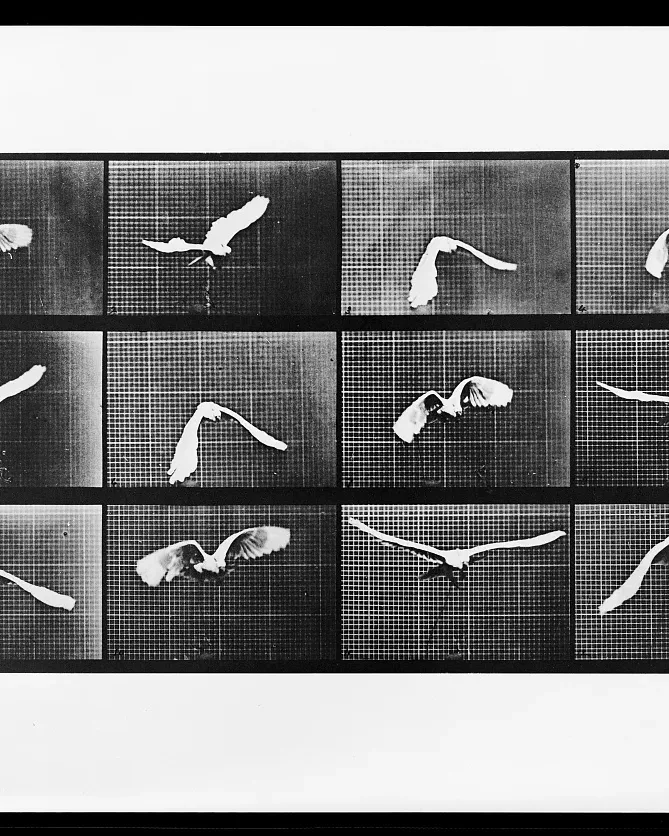
Animal Locomotion. Plate 762
1887
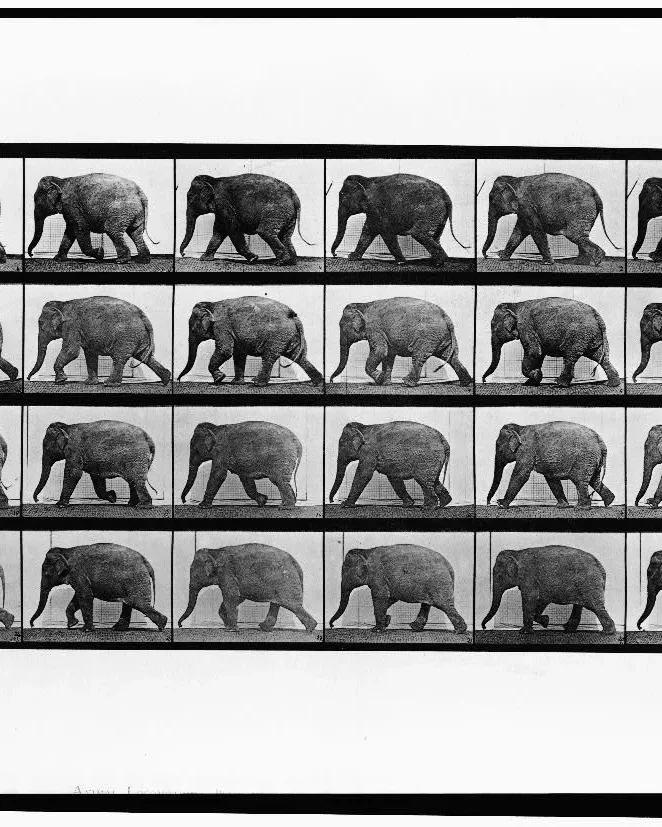
Animal locomotion
1887
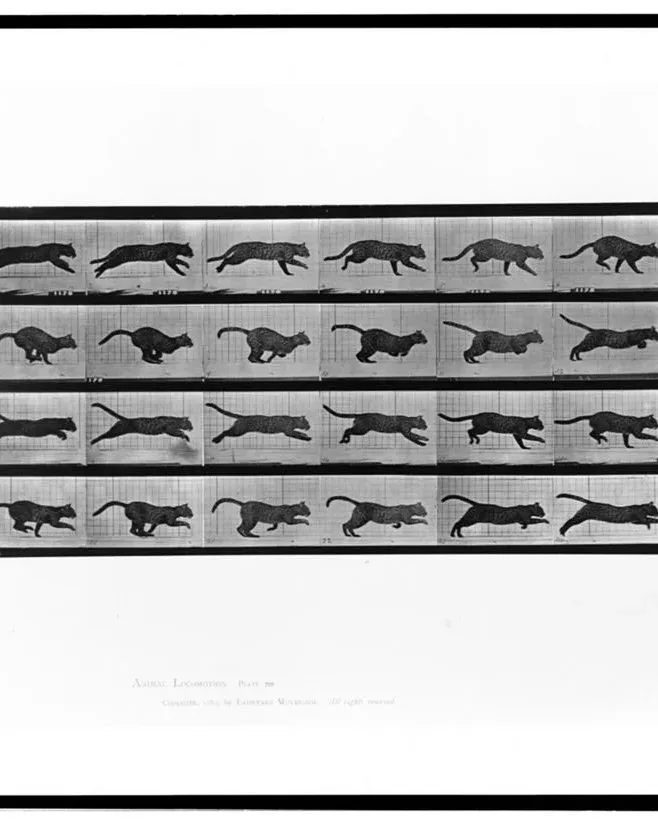
Animal locomotion
1887
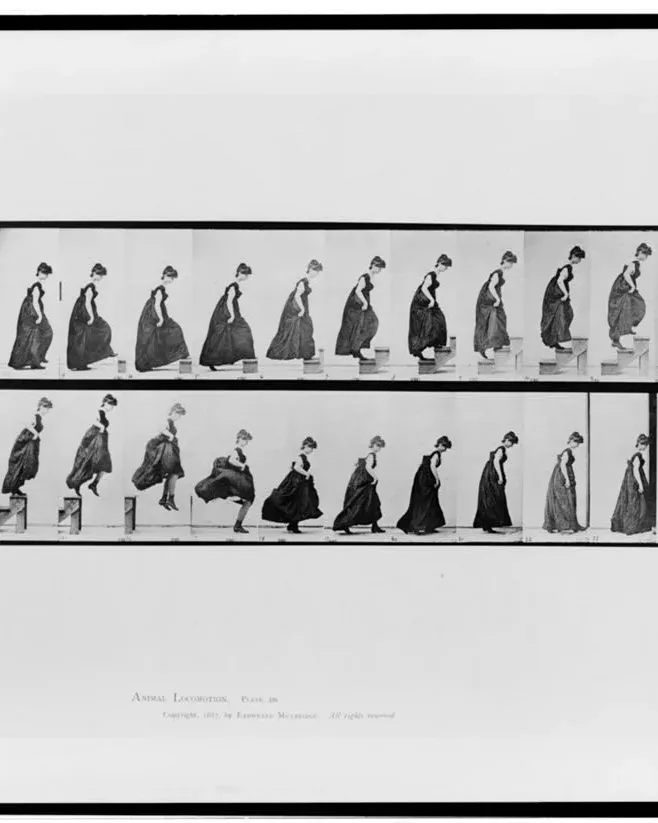
Animal locomotion
1887
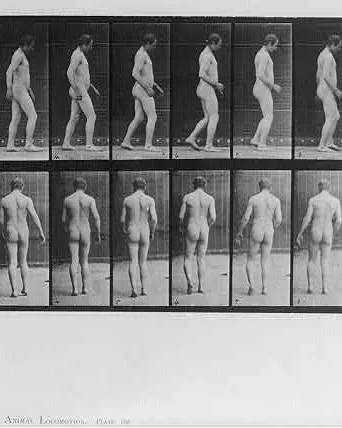
Animal Locomotion: [20 frames of naked man walking - rear…
1887
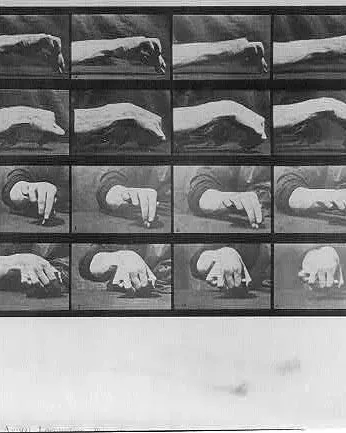
Animal Locomotion: [24 frames of hand drawing chalk circle,…
1887
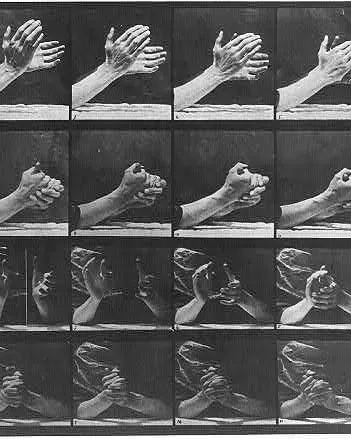
Animal Locomotion: [24 frames of hands clasping, plate 533]
1887
Frequently asked questions
How many plates are in Muybridge's Animal Locomotion?
The complete work has 781 plates, each containing up to 36 photographs. They were selected from more than 100,000 images made at the University of Pennsylvania in 1884 and 1885 and published in 1887.
Who was Annie G.?
Annie G. was a thoroughbred bay mare photographed galloping with a rider for Plate 626 of Animal Locomotion. Her sequence is the source of many of the best-known animations of a running horse.
Is the horse in the movie Nope from Muybridge?
Yes. Nope uses an animation of Plate 626, the Annie G. sequence from Animal Locomotion, and a character in the film claims descent from its rider.
How much did Animal Locomotion cost?
Subscribers paid $100 for 100 plates of their choice. A complete set cost $600, a price so high that reportedly only 37 complete sets were produced.
Where was Animal Locomotion photographed?
Mainly at an outdoor studio on the University of Pennsylvania campus at 36th and Pine Streets in Philadelphia. Animals were also photographed at the Philadelphia Zoo, and racehorses at the Gentlemen's Driving Park.
Sources
- Library of Congress: Animal locomotion - 16 frames of racehorse "Annie G." galloping (catalog record 2006691786)
- University of Pennsylvania Archives: Eadweard Muybridge at Penn
- University of Pennsylvania Archives: Animal Locomotion announcement
- Animal Locomotion (Wikipedia)
- Victoria and Albert Museum: Animal locomotion, man taking off his boater (PH.558-1889)
- Wellcome Collection: Animal locomotion, plate 271